AI is fundamentally changing how people discover information. For public relations professionals, this means that navigating the digital media landscape has become more challenging than ever.
Positioning a brand for discovery on Google or Bing requires SEO (search engine optimization) savvy, but that’s become a fast-moving target thanks to the rise of AI – relatively new platforms like ChatGPT and Perplexity can now provide contextually relevant, detail-rich responses to in-depth user questions (or "prompts").
These AI-driven search engines are becoming popular, too. ChatGPT has an estimated 700 million weekly active users, and that platform alone accounts for nearly 60% of all AI-related web traffic. Additionally, McKinsey & Company research found that 88% of organizations regularly use AI in at least one business function.
What does this mean for PR pros? That your brand and clients now need to be visible in an entirely new search environment. Let’s dig into AI search to define what it is, why it’s important, and how you can leverage it.
How AI is changing search engine discovery
As generative AI filters through into the tools and technology we use every day, it’s become noticeable how it’s altered the way we find information online. Alongside traditional search bar-driven platforms like Google, Bing, and YouTube, ChatGPT, Perplexity, Gemini (and Google’s AI Mode) are becoming primary research tools.
Research tells the story of this behavorial shift. According to Bain & Company, about 60% of searches now end without the user progressing to another destination. "Zero-click" is a result of AI-powered features like Google’s AI Overviews, which now appear in more than 20% of queries.
This represents a big change in how people interact with search engines. We've moved from typing short keywords like "best family car" to asking detailed, conversational questions like "what’s the best SUV car for a family with a three-year-old and a newborn?" Users are now treating search engines less like information retrieval systems and more like knowledgeable, multi-topic assistants.
For PR teams, this behavioral shift has created both challenges and opportunities. Traditional metrics like website traffic and click-through rates no longer tell the complete story. When AI Overviews appear for a query, organic click-through rates are likely to plummet by as much as 65%, according to Seer Interactive.
"LLMs (large language models) are now a new persona that brands need to convince," says Matthieu Danielou, co-founder and CEO of Trajaan. "It’s not just about being cited by LLMs the way brands aimed to be visible in Google Search results – it's about being cited the way they want to be. That shift is completely changing the game of influence."
Defining AI Search: AEO, GEO, and AIO for PR Explained
The emergence of AI search has led to fresh acronyms that PR pros need to understand. Though the SEO community is still consolidating around certain terms, there are three that really matter: AEO, GEO, and AIO.
- AEO (Answer Engine Optimization): This practice focuses on optimizing content to appear in answer-based search features. Think Google's "People also ask" boxes and feature snippets, all elements that provide direct answers to search queries. AEO for PR prioritizes structured, concise content that addresses common questions about your sector. Think of this as old school SEO, but more conversational, designed for the way humans ask and respond to queries.
- GEO (Generative Engine Optimization): Where AEO targets specific answer boxes within traditional search engines, GEO looks to position your brand within AI-generated responses in platforms like ChatGPT, Perplexity, Claude, and Gemini. These AI tools summarize information from multiple sources to create detailed answers. GEO for PR requires content that’s not only discoverable, but also contextually relevant enough that LLMs (large language models) choose to reference or cite it when responding.
- AIO (AI Optimization): AIO refers to a more holistic AI search strategy. It's everything from how LLMs process and understand your content to how they represent your brand in their outputs. Beyond visibility, AIO focuses on three critical elements: sentiment, brand equity, and accuracy. For example, is your brand seen positively? How authoritative are your brand mentions? And are AI tools representing your brand and messaging correctly?
Though there’s overlap between these three approaches, PR pros should think about how they work together. AIO is about making your content readable and authoritative for AI, AEO captures short-form question and answer exchanges, and GEO is about inclusion in longer, synthesized AI responses.
(Note: AIO can also refer to "AI Overviews," the AI-generated responses seen in Google that provide summarized responses to keyword searches.)
What AI search means for PR
Traditional PR success was measured largely through media placements and generating backlinks. Earned media coverage in a top-tier publication meant valuable referral traffic and SEO benefits. But thanks to AI-powered search, being mentioned or cited within an AI-generated answer can carry more weight than being buried in a list of blue links that users may never click.
The game has changed from simply driving traffic; now it's about shaping how your brand is represented in AI responses.
If SEO values ranking for keywords to earn those coveted blue links (and your page position determines success), then by contrast GEO is about visibility through language. It's not where you rank that matters, but whether AI models understand your brand well enough to include you in relevant conversations.
Though there's mystery about how AI models are trained, we know that these systems learn from high quality, trusted sources. Or the same publications PR teams have always targeted. Underscoring this connection is the fact that OpenAI, owner of ChatGPT, has recently partnered with the likes of News Corp, The Guardian, Financial Times, and Hearst. When your brand earns coverage in authoritative publications, you're not just reaching human eyes, you're being scanned by AI models trained to provide future search results.
Yet the foundational principles of quality content haven't disappeared. Google's E-E-A-T framework (Experience, Expertise, Authoritativeness, and Trustworthiness) remains important in AI search. Content that ticks all these boxes will perform well in both traditional SEO and generative AI contexts. PR teams who build their approach on these principles are more than ready for the era of AI search.
Why AI search loves press releases
Here’s some good news: One of the PR industry’s most valuable tools, the press release, is tailor made to help you leverage AI search.
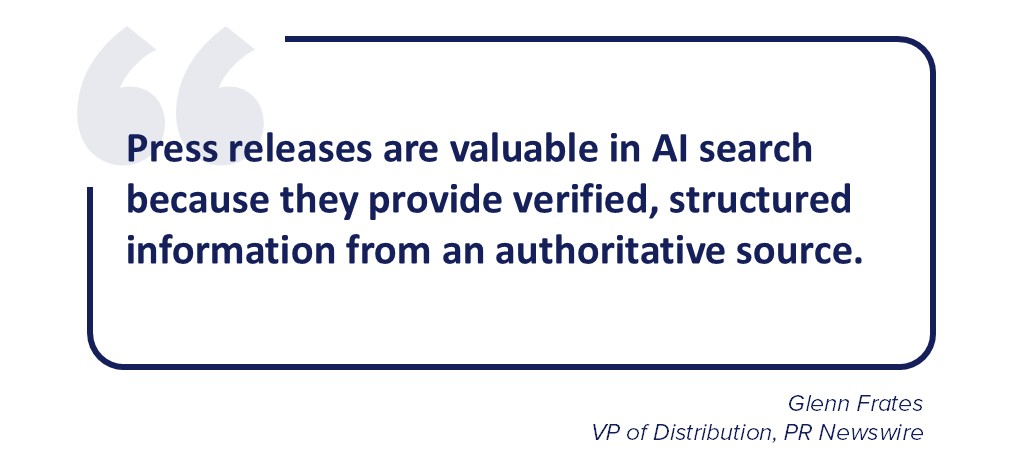
"Press releases are valuable in AI search because they provide verified, structured information from an authoritative source," says Glenn Frates, VP of Distribution, PR Newswire. "AI models are designed to prioritize clarity, consistency and attribution – all of which are built into the press release format. When releases are distributed through trusted newswires, they become reliable reference points that AI systems can confidently cite."
With clear headlines, datelines, quotes, and brand boilerplate sections, AI can easily scan and extract information from press releases. But the benefits don't stop there. If a release gets picked up and syndicated across multiple authoritative publications, that creates a network effect where your brand message appears in many trusted sources. Each syndication is another verified citation – and another signal for AI models to take notice.
Press releases also solve a critical challenge in AI search: Attribution and consistency. Unlike editorial posts or social media content that may interpret your story differently, press releases provide official, quotable statements that establish the definitive version of your news. When AI models encounter consistent information across multiple sources, they're more likely to cite it accurately.
Each press release becomes part of an information bank that trains and informs AI models. So when journalists quote your CEO, or when services like PR Newswire distribute your product launch, this teaches AI systems how to talk about your brand, what you're known for, and why you matter in your industry.
5 tips to build your AI search presence
Here are five practical strategies to keep in mind to help your brand get discovered, be understood, and cited accurately by AI.
1. Prioritize authoritative media placements over quantity
When it comes to AI search for PR, where your brand appears matters more than frequency. A single placement in a recognized industry trade carries more weight than dozens of mentions on lower-authority sites. Focus on earning coverage in publications that AI systems recognize as credible, authoritative sources.
2. Maintain consistent messaging across channels
AI models look for patterns to understand and represent brands. When your messaging varies significantly across press releases, website content, and social media, you confuse the LLMs trying to learn about you. To avoid this, develop core brand messaging and reinforce it everywhere your brand shows up. Consistency gives you a better chance of AI citing you exactly how you want it to.
3. Structure content for AI understanding
AI, like humans, can understand content more effectively when it's well organized. Use descriptive headings, write in clear language, and incorporate structured data wherever possible. As we’ve mentioned, the press release format helps here. Apply similar thinking to all your content, giving AI an easy route to extract key information.
4. Lead with original insights and expert commentary
AI prefers unique insights over generic content. Position your spokespeople as subject matter experts and arm them with data-backed perspectives and original stories. Commentary that adds genuine value to industry conversations will get cited, whereas recycled talking points have more chance of being ignored.
5. Monitor AI platforms
If you want to see if your brand is featured (and represented how you want it to be) in ChatGPT, Gemini, and other AI platforms, then you’ll need to ask them the kind of questions your audience does. For example, if you’re an airline with European routes, are you featured when queried about the best ways to get from London to Paris? And does your airline feature more prominently than the competition (or even another mode of transport like the Eurostar train)?
This may seem like a time-consuming approach, but intelligence platforms like Trajaan can take out the guesswork and make it easy to monitor what the world is searching for with generative AI. Whichever route you go to gather this information, the intel can help you spot emerging trends and position your brand as the answer to the questions being posed.
Final thoughts
AI search for PR isn’t making traditional SEO obsolete just yet, but it is creating an opportunity to build visibility across both disciplines simultaneously. The skills that made you successful in traditional PR remain essential; now you're simply applying them with a new purpose in mind.
While other industries scramble to optimize for generative AI, thanks to the press release and the ability to adapt assets for multiple formats, PR professionals are already well-trained in creating the authoritative, well-structured content these systems seek out.
"The brands that win have always been built on intent – on showing up with the right answer at the exact moment a need is expressed," explains Danielou. "In the age of LLMs, that principle doesn’t change, but the battlefield does.
"Brands now need the technology to monitor the 'intent of humanity' – what people are truly trying to learn, solve, or find through AI – and the technology to start influencing the narratives that AI generates. That’s the new frontier of brand building."
For more information on how Cision and Trajaan can help you better monitor where your brand is showing up in AI search, speak to an expert.
Most Recent Posts
Cision Resources
-
E-books and Guides
Comprehensive how-to guides on strategy and tactics
-
Case Studies
What are other brands doing – and how can we learn from them?

About Simon Reynolds
Simon is the Senior Content Marketing Manager at Cision. He worked as a journalist for more than a decade, writing on staff and freelance for Hearst, Dennis, Future and Autovia titles before joining Cision in 2022.
Learn More. Do More. demo new
PR Tips, Case Studies, and Product Updates


[On-Demand Webinar] The Next Generation of Media Intelligence: From Gorkana to CisionOne
Explore CisionOne, a revolutionary media intelligence platform, and the evolution of Gorkana. Learn key features and strategies from Luke Williams, CisionOne Product Marketing Manager. Elevate your media outreach to new heights!